
REIKI — WHAT IT IS AND HOW IT WORKS
REIKI IS A JAPANESE ART OF ENERGY HEALING — A PRACTICE THAT RECONNECTS US WITH OUR TRUE SELF, WITH WHO WE ARE AT OUR VERY CORE.
This connection is the foundation of Reiki. From it, everything else may naturally arise: stress reduction, dissolving energetic blockages, inner balance, emotional release, deep relaxation, and a sense of coming home to oneself. Although Reiki is often associated with “healing benefits,” its true essence is not transactional. It is a practice of trust and surrender — a way of working with the highest universal energy for our highest good.
The system was developed in the early 20th century by Mikao Usui, a teacher and spiritual practitioner who, after years of study and meditation, introduced Reiki as a simple yet profound method of working with universal life force. Usui created a practice accessible to everyone, regardless of religious or spiritual background, rooted in the understanding that the energy of the Universe flows through us and can support the natural process of healing.
The word Rei means “universal,” and Ki means “life force energy.” Reiki increases the natural flow of “life force” within and around us. It brings a harmonious impulse to areas affected by tension, or imbalance, raising the vibration of the entire energetic field. Reiki, as universal life force energy, is available to every person at any moment.
For me, it simply means:
“My soul is a part of the invisible life force that allows me to live fully as who I truly am — connected with my authentic Self.”
Reiki can be practiced as self-healing, and it can also be shared with others — with people, animals, situations, spaces, and even objects (always with intention and consent). There are countless possibilities for how Reiki can support and uplift life.
Regardless of who receives the energy, the practitioner does not use their own strength. Instead, they serve as a channel through which universal energy flows — whether during a self-practice or when offering sessions to others. Nothing is forced; Reiki simply goes where it is needed most..
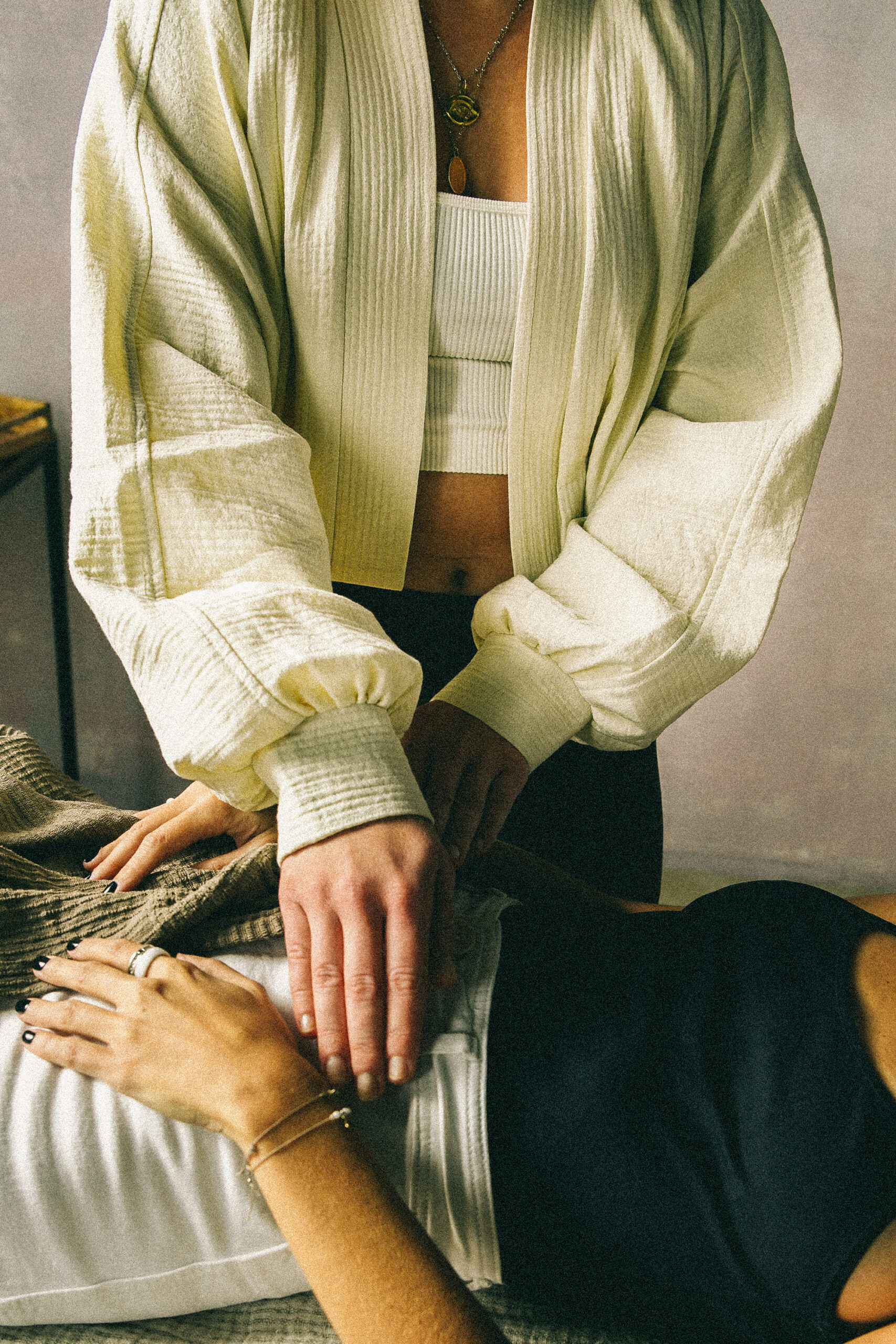
You can experience Reiki through individual sessions or by joining Reiki courses — both pathways open a gentle return to yourself.
Reiki invites you to meet your inner world through meditation and the simple power of touch. It helps you reconnect with your natural rhythm — the place within where clarity, and authenticity arise.
Reiki is not about fixing. It is about feeling — allowing yourself to come home to your own energy.
Whether you choose a session or a course, Reiki becomes a doorway: a quiet space where your energy unwinds, your mind settles, and your true self becomes more visible. Explore individual sessions and Reiki courses to begin your journey inward.
When I first began my Reiki practice, I believed it was “only” a method of healing through touch. Because of this, I treated Reiki as something I used occasionally—mainly when I felt off balance. I expected it to work like a magic pill that would instantly shift how I felt.
What I didn’t yet understand was that reconnecting with one’s own energy is not meant to bring sudden or immediate change. Reiki unfolds gently. It becomes a natural presence woven into everyday life, not something reserved only for meditation or formal practice.
Reiki is not about an instant result; it is about a gradual, steady returning to oneself.
With time, I began to see Reiki differently. I discovered that it illuminates the path toward inner peace and supports harmony with one’s true self. It reveals the healing strength that already exists within us.
Life will always bring challenges and moments that test our resilience. Reiki offers a way to move through these experiences with awareness. It helps transform obstacles into lessons and nurtures a deeper understanding of ourselves. It is the lived recognition that we are energy—and that the Universe continuously supports our growth.
This personal reflection matters because real experiences give meaning to the teachings of Reiki. They allow the practice to become alive rather than remaining a set of abstract ideas. These insights naturally shape the way I share Reiki in my courses and programs. They arise from lived experience, not theory.
Reiki, as I have come to understand it, is not only a method of healing but a path of inner development. It encourages clarity, self-responsibility, and a deeper connection to life. It invites each person to explore their own nature and to discover the quiet power that comes from returning to the essence of who they are.
This is how I understand the practice.
This is how I live it.
Below you’ll find what some people have shared with me after completing their courses. Remember — don’t compare yourself to anyone else. Your Reiki journey is unique, and there is no single perfect way to walk it. For some, the practice unfolds with ease; for others, it takes time and gentle support.
In spiritual practice, it’s not about achieving or striving for something — it’s about reconnecting with yourself and clearing away what dims your inner light. Each of us is different, equal, and beautifully unique.
FEEDBACK AFTER THE SHODEN COURSE :
“First of all, I’d like to thank you once again for the Reiju and all the knowledge you shared. I didn’t expect how important the online course would become — it’s now a part of my daily life. Besides being visually beautiful and cohesive, I honestly can’t imagine not having it, because it so wonderfully continues to guide me into connection with myself and the feeling of energy. For the first time in my life, I sit down to meditate regularly. I’m truly amazed and deeply grateful that you created this course and that it’s part of the attunement experience with you.
The effect of Reiki in terms of compassion and gentleness toward myself is incredible. I’m beginning to feel that my ‘cup’ of self-love is finally filling up — and that now I can share something good with others.”
FEEDBACK AFTER THE SHODEN COURSE :
“Reiki is with me every day; Gokai has become my foundation. I feel so much joy offering sessions to my family and friends. After one session, a friend told me that when I touched the area around her head, she saw a green pillar of light. My sensitivity to energy is growing too — my hands feel very warm 🙂
And it’s this goodness and love that I want to share with others, for their highest good.
I can’t express enough gratitude for finding my way to you for Shoden. Your approach to life completely resonates with mine.”
FEEDBACK AFTER THE OKUDEN COURSE :
“Kasia, I already feel the need to share this today, though I’ll write again after the 21 days.
The first thing — I felt the need to start a journal, because what I’m feeling is so powerful that I have to let some of it flow out.
Kasia, I feel as if I’ve just reached the top of a mountain — very tired, but deeply happy and free. Above all, I feel safe. I’ve arrived home after a long journey.
Thank you so much, Kasia, for helping me find my way here.”
FEEDBACK AFTER THE SHODEN COURSE :
“I know now that whatever happens, it’s meant to be — for my highest good. That there’s always a way through any situation, and whatever comes, I have the strength to face it.
I also understood that if someone hurts me with actions or words, it’s their issue — I don’t have to take it on. I need to take care of myself and hold myself with kindness.
Reiki helps with this — it strengthens forgiveness and brings understanding that some experiences are simply meant to teach us peace. And for that, I’m most grateful.”
FEEDBACK AFTER THE SHODEN COURSE :
“Thank you once again for the initiation and for the wonderful way you prepared everything! I keep listening to the recordings and meditating with you. I’ve now become an advocate for meditation — it’s incredible how powerful it is.”
FEEDBACK AFTER THE OKUDEN COURSE :
“Hi Kasia, I’m writing to share how I’ve been feeling after the Okuden Reiju.
There was no headache — instead, an immense sense of expansion, deep unconditional love, happiness, and tears of joy. I felt as though I had found my home, as if there was nothing more to seek. A profound sense of fulfillment and knowing that this is what I had been looking for. Gratitude and immense Love filling me completely.
I feel the energy and my connection with Reiki much more strongly now. I sense that this is a complete path of spiritual development — one that only needs to be truly explored to experience peace, without distraction or searching outside of oneself.
On my way back, I felt a deep unity with everything. No need to judge what’s good or bad, better or worse — just pure being.
Now, when I sit to practice, it comes as a completely natural impulse — it’s my way of living, my lifestyle. Meditating with the first symbol truly feels like switching something on; I immediately drop into the state that used to take me 15 minutes to reach before. Now the connection comes instantly — and tears of joy simply flow.”
The teachings I share are rooted in Usui Shiki Ryoho Reiki, the traditional system that comes directly from the lineage of Mikao Usui. It is a method of working with energy whose essence lies in restoring balance and supporting the body’s natural ability to heal.
“Shiki Ryoho” means “the natural method of healing.” This reminds us that Reiki is not about adding something external. It is about awakening what already exists within us and around us. This form of Reiki emphasizes simplicity, a direct connection to the source, and the importance of daily practice that cultivates self-awareness and harmony between body, mind, and spirit.
For this reason, Usui Shiki Ryoho is not only a healing method — it is also a path of spiritual development and a way of returning to our true nature.
There is no single organization or school that exclusively governs Reiki today. Mikao Usui passed away relatively early and never intended Reiki to become a rigid system or institution. As the practice spread globally, it naturally evolved in different forms. Each generation of teachers contributed their own understanding and experience.
Today, Reiki is known worldwide, yet under the same name we find many distinct approaches. The two most commonly recognized are:
The Eastern (Japanese) approach — closely aligned with Usui’s original simplicity and spiritual foundation.
The Western approach — shaped largely by Hawayo Takata, often emphasizing symbols and structured teaching methods.
The Western approach frequently integrates elements from other systems such as the chakra model, kundalini concepts, and additional spiritual or energetic traditions. It tends to be more technical and structured, offering clear methods, rituals, and tools that can be easier to understand for the contemporary analytical mind.
The Eastern approach, in contrast, preserves minimalism and direct experience. It focuses on the natural flow of energy, meditation, presence, and reconnecting with the source through silence and awareness. It does not rely heavily on additional symbolic systems or layered frameworks. It returns to the heart of Reiki as a way of being, not merely a technique.
The teachings I share draw from both perspectives, with a strong emphasis on deepening the understanding of the Japanese roots. The closer we move toward the original teachings of Mikao Usui, the more clearly we sense the depth he intended to transmit — a spiritual practice rather than a set of techniques.
(Those wishing to explore this further may find the work of Frans Stiene especially insightful; his research, books, and teachings highlight Reiki as a path of spiritual development rooted in traditional Japanese practice.)
Why emphasize this distinction?
Because Reiki today is taught in many different ways. The Japanese perspective resonates deeply with me — yet I do not limit myself solely to it. Each person is unique. Some elements of my work draw from Western methods, while others remain faithful to Japanese foundations. What aligns with me may not be what aligns with someone else — and that is entirely natural.
My intention is to share Reiki as I understand and experience it, while creating space for others to discover their own connection to the practice.
There is no single “perfect” way to practice Reiki. Exploring different perspectives and learning from diverse teachers helps each person understand what Reiki becomes in their own life. For some, the Western approach may feel more relatable; for others, the Japanese tradition may resonate more deeply. Regardless of the form one chooses, what truly matters remains the same: the relationship with one’s own energy — a unique expression of life force unlike any other.
Reiki and energy practices are complementary modalities that can support emotional balance and inner harmony. They are not methods for diagnosing, treating, or curing physical or psychological conditions. For more information, please read the legal disclaimer:
https://kasiawacenergia.com/legal-disclaimer/